Who was Mustafa Kemal Atatürk? Bio & Death

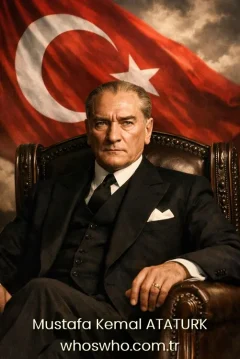
Mustafa Kemal Atatürk was a Mustafa Kemal Atatürk was a Turkish military commander statesman and the founding president of the Republic of Türkiye who led the Turkish War of Independence and introduced sweeping political social and cultural reforms that shaped the modern Turkish state. He was born on May 19, 1881 in Salonica,Ottoman Empire. his zodiac sign was Taurus. He died on November 10, 1938 at the age of 57.
Mustafa Kemal Atatürk's Biography Score and Ranking Status on Our Website
| Score | Gender | Year | Country |
|---|---|---|---|
| 81/100 | Male Rank #25 | 1881 Rank #1 | Ottoman-empire Rank #1 |
The Turkish field marshal, revolutionary Statesman, and author Mustafa Kemal Atatürk established a monumental role in modern History as the founding father and first President of the Republic of Türkiye. Born in 1881 in the Ottoman port city of Salonica (now Thessaloniki, Greece), he grew up in a modest household as the son of Ali Rıza Efendi, a customs official and timber merchant, and Zübeyde Hanım. Throughout his lifetime, which concluded on November 10, 1938, his transition from a brilliant Ottoman military officer into a visionary nation-builder fundamentally reshaped the political, legal, and social landscape of the Near East. His leadership transformed the remnants of a collapsed empire into a secular, progressive, and unified nation-state rooted in democratic sovereignty.
Academic Foundations and Elite Military Formation
Mustafa Kemal completed his early primary education in Salonica, initially attending the traditional religious Mahalle Mektebi before transferring to the modern secular institution of Şemsi Efendi Mektebi at his father’s request. Following his father’s untimely passing, he briefly stayed in the rural district of Langaza before returning to Salonica to continue his education. Driven by a strong determination to pursue military service, he took the admissions exams for the Salonica Military Secondary School (Selanik Askeri Rüştiyesi) in 1893. It was within this institution that his mathematics instructor bestowed upon him the honorific name Kemal (meaning perfection), establishing his lifelong public moniker.
His advanced strategic preparation expanded rapidly through the elite military academies of the Ottoman state. In 1896, he entered the Monastir Military High School (Manastır Askeri İdadisi) in modern-day North Macedonia, where he excelled in history and literature, while becoming deeply influenced by Enlightenment philosophers like Jean-Jacques Rousseau and Voltaire. He moved to the imperial capital in 1899, entering the Ottoman Military College (Mekteb-i Harbiye) in İstanbul and graduating as a Lieutenant in 1902. He subsequently secured a placement at the prestigious General Staff Academy (Erkân-ı Harbiye), graduating as a Staff Captain on January 11, 1905.
Early Deployments, Strategic Warfare, and Global Conflicts
Staff Captain Mustafa Kemal initiated his professional military career in the Ottoman Fifth Army based in Damascus between 1905 and 1907. Confronted by regional administrative inefficiencies, he co-founded Vatan ve Hürriyet (Fatherland and Freedom), a clandestine reformist society aimed at structural modernization. He was later reassigned to the Third Army in Macedonia, playing a crucial operational role in the 1909 Action Army (Hareket Ordusu) that suppressed the countercoup in İstanbul. Seeking practical battlefield experience, he volunteered for deployment during the 1911 Italo-Turkish War in Libya. In the defenses of Derne and Tobruk, he successfully organized local tribal resistance forces against conventional Italian military advances, mastering guerrilla tactics despite sustaining a serious eye injury.
Upon the outbreak of the Balkan Wars (1912–1913), Mustafa Kemal relocated to the Gallipoli Peninsula, managing critical defensive networks along the Bolayır isthmus. Following the cessation of hostilities, he was appointed as the Ottoman Military Attaché to Sofia in 1913, where he engaged extensively with the European diplomatic corps and achieved promotion to the rank of Lieutenant Colonel. His strategic insight gained global recognition during World War I. As the Commander of the 19th Division, he orchestrated the legendary defensive stands during the 1915 Gallipoli Campaign (Çanakkale Savaşları).
Anticipating the exact coordinates of the Allied landings at Anafartalar, Conkbayırı, and Arıburnu, his decisive tactical commands thwarted British and French imperial maneuvers, effectively safeguarding İstanbul from naval occupation. Promoted to Colonel and later to Brigadier General (Pasha) in 1916, he assumed command of the Caucasus Front, where his forces successfully recaptured Muş and Bitlis from Russian units. He concluded his wartime deployment on the Palestine Front as the Commander of the Seventh Army and the Yıldırım Army Group, executing highly organized strategic retreats north of Aleppo to preserve the core of the Turkish military forces prior to the signing of the Armistice of Mudros in October 1918.
The War of Independence and the Ankara Government
The signing of the Mudros Armistice led to widespread Allied occupations across Ottoman territories, partitioning Anatolian and Thracian lands under the severe terms that would later form the Treaty of Sèvres. Refusing to accept the capitulations of the İstanbul government, Mustafa Kemal secured an assignment as the Inspector of the 9th Army Troops. On May 19, 1919, he landed in the Black Sea port of Samsun, a pivotal milestone that marked the official start of the Turkish War of Independence (Kurtuluş Savaşı). He immediately began unifying local resistance groups (Müdafaa-i Hukuk) by issuing the Amasya Circular, which declared that the independence of the nation would be saved by the resolve and determination of the nation itself.
To institutionalize the national movement, he resigned from his commission in the Ottoman army and presided over the historic Erzurum and Sivas Congresses in late 1919. These assemblies drafted the National Pact (Misak-ı Millî), defining the unalterable borders of a sovereign Turkish state. On April 23, 1920, he officially inaugurated the Grand National Assembly of Turkey (TBMM) in Ankara, establishing a provisional government and being elected as its first Speaker. Serving as Commander-in-Chief, he managed a multi-front military campaign, coordinating defense operations in the South and East while concentrating major forces against the Greek military advance in Western Anatolia.
His military strategy proved decisive during the multi-week Battle of Sakarya in 1921, where his tactical directive—stating that there is no line of defense but a whole area of defense, which is the entire homeland—earned him the title of Gazi (Warrior) and the rank of Field Marshal from the TBMM. He finalized the military campaign through the Great Offensive (Büyük Taarruz) launched on August 26, 1922, culminating in the liberation of İzmir on September 9 and the complete evacuation of occupying forces from Anatolia. Subsequent diplomatic negotiations resulted in the Treaty of Lausanne on July 24, 1923, which nullified the Sèvres dictates, secured international recognition, and established the official boundaries of the new Turkish nation.
The Proclamation of the Republic and Secular Reforms
With national sovereignty internationally recognized, Mustafa Kemal initiated a comprehensive restructuring of the country’s administrative and legal framework. On October 29, 1923, the Grand National Assembly officially proclaimed the Republic of Türkiye, and Mustafa Kemal was unanimously elected as its first President. He subsequently co-founded the Republican People’s Party (CHP) as the primary political vehicle to implement sweeping social and political reforms based on the principles of Kemalism, which integrated republicanism, nationalism, populism, statism, secularism, and reformism.
His modernization program focused heavily on the complete separation of state and religious affairs. On March 3, 1924, his administration officially abolished the Ottoman Caliphate, unified national education under secular standards (Tevhid-i Tedrisat), and dissolved religious courts. He replaced traditional religious laws with modern Western legal codes, adopting a comprehensive Swiss-based Turkish Civil Code in 1926. This landmark legislation granted full legal equality to women, banned polygamy, and secularized marriage contracts. His cultural reforms also included the adoption of the Western calendar, the modernization of traditional attire, and the landmark 1928 Alphabet Reform, which replaced the Arabic script with a tailored Latin-based Turkish alphabet, rapidly increasing national literacy rates.
Industrialization and Foreign Policy
Throughout the 1930s, President Atatürk guided the nation through an era of state-led economic development and self-sufficiency, navigating the global pressures of the Great Depression. He implemented the First Five-Year Industrial Plan in 1933, financing the construction of state-owned factories, Textile complexes, iron and steel foundries, and national mining enterprises such as Etibank and Sümerbank. He also established model agricultural farms, modernized national infrastructure by extending the railway network, and centralized financial operations by founding the Central Bank of the Republic of Türkiye.
In foreign policy, Atatürk maintained a firm stance of neutrality and international cooperation, summarized by his definitive guiding principle: “Peace at home, peace in the world” (Yurtta sulh, cihanda sulh). He orchestrated the signing of the Balkan Pact (1934) and the Treaty of Sadabad (1937), establishing non-aggression alliances with neighboring countries. His diplomatic efforts achieved a major milestone through the 1936 Montreux Convention, which restored complete Turkish sovereignty over the vital Bosporus and Dardanelles Straits. In 1934, following the enactment of the Surname Law, the Grand National Assembly unanimously bestowed upon him the singular surname Atatürk (meaning Father of the Turks), legally restricting its use from any other individual.
Physical Profile, Legacy, and Final Rest
Mustafa Kemal Atatürk stood at a height of 1.74 meters (5 feet 8 and a half inches), with his official records noting his baseline weight at approximately 72 kilograms (158 lbs) during his active years as a statesman. Regarding his personal life, he married Latife Uşaklıgil (Latife Hanım) on January 29, 1923; however, the marriage concluded by mutual agreement on August 5, 1925. He had no biological children but legally adopted several children, including prominent historian Afet İnan and pioneering aviator Sabiha Gökçen.
Decades of intense military and political leadership took a heavy toll on his health. Diagnosed with liver cirrhosis in early 1938, he continued his national duties until his final months. On November 10, 1938, at 09:05 AM, he passed away at the Dolmabahçe Palace in İstanbul at the age of 57. Following a national period of mourning and a temporary resting place in Ankara, his remains were permanently transferred to his monumental mausoleum, Anıtkabir, on November 10, 1953.
In his official last will and testament, Atatürk bequeathed his personal real estate holdings, agricultural Model farms, and assets to the nation, allocating their management to the Turkish Historical Society (TTK) and the Turkish Language Association (TDK), while ensuring provisions for his family and adopted children. His visionary framework remains the cornerstone of modern Türkiye and an enduring global symbol of sovereign modernization.
Mustafa Kemal Atatürk – Frequently Asked Questions (FAQ)
Latest on Mustafa Kemal Atatürk

Check out our 1881 born celebrities page to discover Mustafa Kemal Atatürk and other notable people born in the same year.